TurboTax

With all the different file formats that are found in everyday computing, most formats which find their way to my archive have historical value. We know we can’t keep everything and have to assign value to all we decide to keep in for the long term. Some files have sensitive data and we have to follow guidelines for their proper handling. Identification of files helps us know what type of data might be kept inside the format, so often I need to also identify formats we don’t plan on keeping.

I was recently looking through a large digital collection and a report on the files which did not identify in the initial scan. A few popped out to me because of their extension, TAX. Tax records are one thing we need to identify so we can properly handle them, but not likely keep in our repository.

These tax files come from the popular US based TurboTax software. The software gets a new version for every year as tax laws are constantly changing. The software has also been around since 1984, so there are many versions to be aware of. Add to the fact there are personal and business versions along with DOS, Windows, and Macintosh versions, identification might get complicated. None of which are documented in the PRONOM registry. Wikidata is aware of a couple of the extensions, but does not have any signatures to help in identification.

Luckily, this collection of files I was processing had a number of years worth of records. Using them and a few others I was able to put together a decent timeline of formats used, at least from the early 1990’s on. The format seemed to settle on the .TAX extension around the 1994 Windows version. Before this, a group of files in DOS together stored the data. Let’s look at a sample of the 1994 file from Windows.

% hexdump -C TT1994.TAX | head
00000000 54 75 72 62 6f 54 61 78 0d 0a 46 6f 72 6d 61 74 |TurboTax..Format|
00000010 3d 57 49 4e 0d 0a 56 65 72 73 69 6f 6e 3d 31 33 |=WIN..Version=13|
00000020 0d 0a 45 6e 67 69 6e 65 56 65 72 73 53 74 72 3d |..EngineVersStr=|
00000030 36 2e 30 30 2e 31 0d 0a 46 6f 72 6d 73 65 74 3d |6.00.1..Formset=|
00000040 53 31 39 39 34 55 53 31 30 34 30 0d 0a 43 65 6e |S1994US1040..Cen|
00000050 74 73 3d 59 65 73 0d 0a 53 68 6f 77 43 6f 6d 6d |ts=Yes..ShowComm|
00000060 61 73 3d 59 65 73 0d 0a 53 68 6f 77 43 6f 6c 6c |as=Yes..ShowColl|
00000070 61 70 73 69 62 6c 65 57 6f 72 6b 53 68 65 65 74 |apsibleWorkSheet|
00000080 73 3d 59 65 73 0d 0a 44 61 74 61 56 65 72 73 69 |s=Yes..DataVersi|
00000090 6f 6e 3d 31 0d 0a 46 6f 72 6d 46 69 6c 65 53 75 |on=1..FormFileSu|

I love these easy to identify format headers, but then jump to the next year, 1995, and the format changes.

% hexdump -C TT1995.TAX | head
00000000 c0 45 01 5f 0a 00 00 35 b5 06 36 2e 30 30 2e 31 |.E._...5..6.00.1|
00000010 00 00 c7 00 02 00 02 0d 00 00 00 b4 00 00 00 d9 |................|
00000020 00 0e 53 31 39 39 35 55 53 31 30 34 30 50 45 52 |..S1995US1040PER|
00000030 01 01 01 00 00 00 01 00 01 00 00 35 b5 00 0a c8 |...........5....|
00000040 00 01 00 01 09 00 00 00 cf 00 06 00 06 1d 00 00 |................|
00000050 00 3e 00 00 00 3e 00 00 00 64 00 00 00 64 00 00 |.>...>...d...d..|
00000060 00 7e 00 00 00 ce 13 7a 65 7a 50 65 72 73 69 73 |.~.....zezPersis|
00000070 74 65 6e 74 53 74 61 74 75 73 00 65 00 64 00 01 |tentStatus.e.d..|
00000080 00 00 00 00 00 00 ce 12 7a 74 6c 50 65 72 73 69 |........ztlPersi|
00000090 73 74 46 69 6c 65 44 61 74 61 00 00 00 00 00 00 |stFileData......|

The nice easy to read header is gone, but some other patterns start to appear. It seems most of the files from these early versions also used a code near the beginning that may help. “S1995US1040PER”, is similar to the “S1994US1040” in the 1994 file. One could assume the “1040” is the tax form most Americans are used to, along with “US” preceding the number. Then at the end of the string we see “PER”. This may refer to different versions of the Tax software, a Personal for the individual, and a possibly other versions for business as well. I believe TurboTax also had versions for Canadians as well, so there may be many variations on this string. This could get complex. Let’s jump ahead to a 1999 file.

% hexdump -C TurboTax1999.tax | head 
00000000 c0 45 01 5f 0a 00 00 54 6a 16 4c 39 31 30 32 31 |.E._...Tj.L91021|

00000030 00 0e 53 31 39 39 39 55 53 31 30 34 30 50 45 52 |..S1999US1040PER|
00000040 00 00 01 00 00 00 25 00 00 00 00 00 00 00 00 00 |......%.........|
00000050 01 19 12 8f f1 00 0a 00 00 00 00 00 00 00 00 00 |................|
00000060 00 00 00 00 00 00 00 00 00 00 00 00 00 00 00 00 |................|
00000070 00 00 00 00 00 00 00 00 00 00 00 00 00 00 00 c8 |................|
00000080 00 04 00 04 15 00 00 00 ec 05 00 00 c3 07 00 00 |................|
00000090 a3 08 00 00 c4 00 05 46 31 30 34 30 00 00 00 01 |.......F1040....|

The same string is visible, but if course with the year “1999”. We can also see a pattern with the first 4 bytes, “c0 45 01 5f” which seem to be consistent with the 1995 file. The file I have for 1998 is consistent as well. Jumping to the new millennium, we see a change.

% hexdump -C TurboTax2000.tax | head
00000000 c0 45 01 64 0a 00 00 2e 4f 18 4c 30 30 39 32 37 |.E.d....O.L00927|

00000030 00 dc 00 0b 53 32 30 30 30 55 53 31 31 32 30 00 |....S2000US1120.|
00000040 00 01 00 00 00 09 00 00 00 00 00 00 00 00 00 01 |................|

Two changes we see with this file. One, the ASCII string is different. S2000US1120, 1120 being the U.S. Corporation Income Tax Return. So this version of the software was different. The other change is the first 4 bytes. They changed to “c0 45 01 64”, with the last byte changing from 5F to 64. Jumping to 2003, we see the same values.

% hexdump -C TurboTax2003.tax | head 
00000000 c0 45 01 64 0d 00 00 80 1b 26 54 59 30 33 5f 4c |.E.d.....&TY03_L|

00000040 58 03 00 dc 00 0e 53 32 30 30 33 55 53 31 30 34 |X.....S2003US104|
00000050 30 50 45 52 00 00 01 00 00 6a c6 00 00 00 00 00 |0PER.....j......|

Back to a 1040 form, but with the same header as the 2000 file. I am removing some lines, just to be safe and not exposing any personal data. In 2004 we see a major change in the format.

% hexdump -C TurboTax2004.tax | head 
00000000 54 54 46 4e 01 01 6f 68 dc 62 00 00 00 00 4b 01 |TTFN..oh.b....K.|

Again, removing some lines to ensure safety. This header is very different and their is no human readable ASCII in the file, which means it is binary and probably encoded. This header is new, TTFN is what I assume references TurboTax format? file? or possibly, “Turbo Tax Financial Network“?

This header is then used for the next few years ending in 2013, but before we get there, the extension makes a change as well. In 2008, instead of the simple .TAX extension, the software begins to save the tax file with the extension .TAX2008. I don’t have a 2008 document, but I do have a sample 2009 document.

% hexdump -C TurboTax2009.tax2009 | head
00000000 54 54 46 4e 01 01 b5 68 02 24 00 00 00 00 4b 0b |TTFN...h.$....K.|
00000010 01 01 19 13 01 01 01 52 01 01 01 0b 01 01 4e 7a |.......R......Nz|

With the last to use the TTFN header in 2013.

% hexdump -C TurboTax2013.tax2013 | head
00000000 54 54 46 4e 01 01 87 22 6a ec 00 00 00 00 50 bd |TTFN..."j.....P.|

2014 is where I get a little confused. I have one file which uses the TTFN header and another which uses what becomes the standard going forward. But definitely in 2015, the format starts using the ZIP container as a structure for the format. Here is a sample from 2015

% hexdump -C TurboTax2015.tax2015 | head
00000000 50 4b 03 04 2d 00 02 00 08 00 e5 a6 51 48 ba 4d |PK..-.......QH.M|
00000010 43 67 15 06 00 00 10 06 00 00 0c 00 14 00 6d 61 |Cg............ma|
00000020 6e 69 66 65 73 74 2e 78 6d 6c 01 00 10 00 00 00 |nifest.xml......|

If we take a look inside the ZIP container of a 2017 dummy sample.

% 7z l TurboTax2017.tax2017
7-Zip [64] 17.05 : Copyright (c) 1999-2021 Igor Pavlov : 2017-08-28
p7zip Version 17.05 (locale=utf8,Utf16=on,HugeFiles=on,64 bits,8 CPUs LE)

Scanning the drive for archives:
1 file, 769814 bytes (752 KiB)

Listing archive: TurboTax2017.tax2017

--
Path = TurboTax2017.tax2017
Type = zip
WARNINGS:
Headers Error
Physical Size = 769814

Date Time Attr Size Compressed Name
------------------- ----- ------------ ------------ ------------------------
2026-03-28 20:25:38 ..... 576 581 manifest.xml
2026-03-28 20:25:38 ..... 768688 768923 084A702A-CD3D-4623-B8B7-EE4800BB151F
------------------- ----- ------------ ------------ ------------------------
2026-03-28 20:25:38 769264 769504 2 files

Warnings: 1

The files all seem to have a manifest.xml and a unique identifier. 7-Zip also mentions a header issue with the ZIP files. Something maybe done on purpose? Now comes the odd part, the manifest.xml file does not render as an XML file, it is binary.

% hexdump -C TurboTax2017/manifest.xml | head
00000000 a1 b1 fe fb 37 18 dd 9c 08 2d 9c 86 23 00 10 fa |....7....-..#...|
00000010 12 60 92 bb dc 92 a5 df 1a 24 16 4e a9 28 89 80 |.`.......$.N.(..|
00000020 64 33 66 55 c5 93 f0 68 44 d0 7c f9 56 86 42 2c |d3fU...hD.|.V.B,|
00000030 80 ba 8a 95 2a 82 6d 32 75 84 b1 f1 e2 18 93 5c |....*.m2u......\|
00000040 82 4d 18 f9 ed 23 4f dc d6 b5 7f f2 20 1e 30 59 |.M...#O..... .0Y|
00000050 d5 7f 47 7d aa f5 8d bd 8b 10 20 ec 8a c7 43 df |..G}...... ...C.|
00000060 52 90 a9 70 4d 68 b4 76 fa c8 37 85 f5 56 25 82 |R..pMh.v..7..V%.|
00000070 ea 16 06 54 b0 b4 bc 43 16 fb 70 7b 7a 79 a5 8b |...T...C..p{zy..|
00000080 3c 79 7d ef ac 32 fc 35 ce 0f fa a2 6f e7 c3 a4 |<y}..2.5....o...|
00000090 92 a1 a4 c8 83 dd 9f 32 f4 ea d3 1a eb 89 15 a3 |.......2........|

Of the samples I have which have a manifest.xml, they all begin with “a1 b1 fe fb”. Which apparently is the header for an AES CBC encrypted file. A clever person was able to decrypt the file to reveal the actual XML.

TurboTax isn’t sold on physical disk anymore, but you can download the current tax year version from their website. I am not a user of their product so I am not sure if the latest version still saves files in the same way. If you do use it currently, I would love to know if it is still the same.

So to recap, the headers are:

  • 1994 “TurboTax Format=WIN Version=13
  • 1995-99 “C045015F”
  • 2000-03 “C0450164”
  • 2004-13 “TTFN”
  • 2014-current “ZIP Container”

This should be enough to create five new signatures for identification. Extensions will be a problem since they change very year, but we can add them to the list. With these signatures we can now identify all the tax files we have and set them aside if not needed.

iView

It seems to be a common theme through the history of software that some titles, get bought, sold, rebranded, integrated, and discontinued by a number of companies. I find it interesting to find out a popular software title’s humble beginnings. Often when a piece of software gets bought, the file formats don’t change much, at least at first.

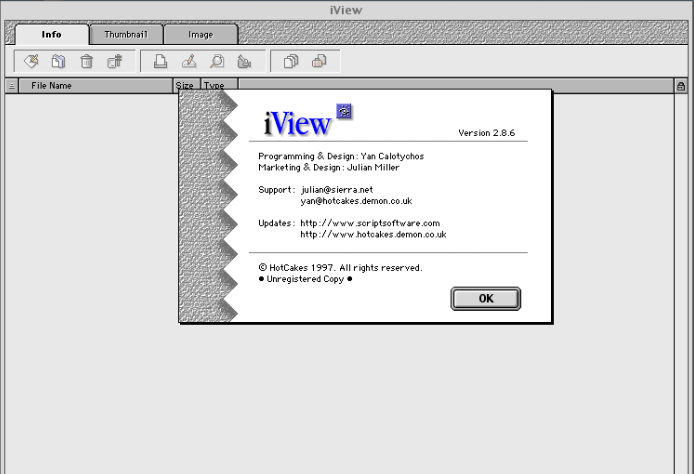
A little shareware program called iView started out by a company called Script Software in 1996. They later changed their name to Plum Amazing. iView then became iView Multimedia, then an iView MediaPro version before it was bought by Microsoft where they changed the name to Expression Media. After a couple years the software was bought by Phase One and then discontinued. Let’s take a look at the history.

iView, according to their website in 1997, is simply the easiest and fastest way to view and catalog pictures for the Mac. The software initially only worked on the Macintosh and the Catalog file it produced did not have an extension. But they did have a Type/Creator code. A catalog produced by version 2 of the iView software was IVWc/IVW2.

% hexdump -C iView2-s01 | head
00000000 00 00 00 05 30 32 35 69 47 4f 53 58 3a 4c 69 62 |....025iGOSX:Lib|
00000010 72 61 72 79 3a 41 70 70 6c 69 63 61 74 69 6f 6e |rary:Application|
00000020 20 53 75 70 70 6f 72 74 3a 41 70 70 6c 65 3a 69 | Support:Apple:i|
00000030 43 68 61 74 20 49 63 6f 6e 73 3a 46 72 75 69 74 |Chat Icons:Fruit|
00000040 3a 47 72 65 65 6e 20 41 70 70 6c 65 2e 67 69 66 |:Green Apple.gif|
00000050 03 46 44 63 00 00 0f ef 03 46 44 63 08 93 65 58 |.FDc.....FDc..eX|
00000060 00 01 5c 50 00 01 5a c8 68 ff f7 40 08 93 65 4b |..\P..Z.h..@..eK|
00000070 08 13 9a c0 ff d1 3a 80 00 a3 c8 a0 00 00 28 00 |......:.......(.|
00000080 00 05 48 64 00 00 a0 24 00 00 39 ec 00 00 00 0a |..Hd...$..9.....|
00000090 08 93 65 64 44 00 00 24 3d 14 51 84 3d 9d 74 bc |..edD..$=.Q.=.t.|

The iView format is a proprietary binary format used to store a catalog of multimedia formats with their metadata and thumbnail. The media viewer had support for quite a few popular formats. The file seems to have paths to each of the files it has cataloged, so some of these iView files can get pretty large.

In 2003 the iView software was ported to Windows. With that brought a formal extension to the catalog format. This was also the time the iView software made the switch from the classic MacOS to MacOSX and extensions were also encouraged at this time. iView had two different version a standard shareware version and a Media Pro version, each had their own version numbers. iView MediaPro was not compatible with Macintosh 68K machines or systems earlier than 8.6. The last Media Pro version was version 3.8.6. You can get most of the old software versions here.

% hexdump -C iViewPro302-s01.ivc | head
00000000 00 00 00 00 30 32 35 69 46 53 4d 21 00 00 00 2e |....025iFSM!....|
00000010 66 6c 64 72 00 00 00 2e 00 00 00 00 00 00 00 06 |fldr............|
00000020 00 00 00 00 00 00 00 00 00 00 00 00 00 00 00 00 |................|
00000030 00 00 00 00 00 00 00 00 3c 72 6f 6f 74 3e 42 4c |........<root>BL|
00000040 44 4f 00 00 00 0c 31 00 02 00 00 00 01 01 00 00 |DO....1.........|
00000050 00 00 55 53 46 33 00 00 00 02 01 03 43 4d 52 53 |..USF3......CMRS|
00000060 00 00 01 ed 01 00 00 02 0a 01 00 00 00 00 00 00 |................|
00000070 00 02 f2 01 00 00 00 00 00 00 00 00 a2 01 00 00 |................|
00000080 00 00 02 01 03 00 00 00 a1 01 00 00 00 00 00 00 |................|
00000090 00 00 48 00 00 00 00 00 00 00 00 00 03 01 00 00 |..H.............|

This time with an extension, IVC, but with a familiar pattern at the beginning. The string 025i, hex values “30323569” at byte 4. The iView files from previous versions have the same bytes, but only version Media Pro 2 & 3 files match an existing PRONOM identification.

% sf iViewPro302-s01.ivc 
filename : 'iViewPro302-s01.ivc'
filesize : 3757
modified : 2025-09-17T17:39:27-06:00
errors :
matches :
- ns : 'pronom'
id : 'fmt/647'
format : 'Microsoft Expression Media'
version : '2'
mime :
class : 'Presentation'
basis : 'extension match ivc; byte match at [[4 4] [3737 16]]'

These are iView Media Pro files, why are they identifying as Microsoft Expression Media files? That is because Microsoft bought iView Media Pro on June 27, 2006. Microsoft rebranded the software as Expression Media, not to be confused with Expression Studio. It was available for Windows and Macintosh, but not everyone was happy with the purchase. Version 1 of Expression Media was released the next year and was a free upgrade for iView Media Pro users. The format doesn’t appear to have changed much at all. In fact a comparison of an iView Media Pro 3 file with no content and an Expression Media 1 file are practically identical.

% hexdump -C Expression1-s01.ivc | head
00000000 00 00 00 00 30 32 35 69 46 53 4d 21 00 00 00 2e |....025iFSM!....|
00000010 66 6c 64 72 00 00 00 2e 00 00 00 00 00 00 00 06 |fldr............|
00000020 00 00 00 00 00 00 00 00 00 00 00 00 00 00 00 00 |................|
00000030 00 00 00 00 00 00 00 00 3c 72 6f 6f 74 3e 42 4c |........<root>BL|
00000040 44 4f 00 00 00 0c 31 00 02 00 00 00 01 01 00 00 |DO....1.........|
00000050 00 00 55 53 46 33 00 00 00 02 01 03 43 4d 52 53 |..USF3......CMRS|
00000060 00 00 01 ed 01 00 00 02 0a 01 00 00 00 00 00 00 |................|
00000070 00 02 f2 01 00 00 00 00 00 00 00 00 a2 01 00 00 |................|
00000080 00 00 02 01 03 00 00 00 a1 01 00 00 00 00 00 00 |................|
00000090 00 00 48 00 00 00 00 00 00 00 00 00 03 01 00 00 |..H.............|

The next year brought a version 2 of Expression Media, often found bundled with a Special Edition of Office 2008 for Mac, but also a standalone product for Windows. But the catalog format remained the same.

% hexdump -C Expression2-s01.ivc | head       
00000000 00 00 00 04 30 32 35 69 3a 43 3a 5c 44 4f 43 55 |....025i:C:\DOCU|
00000010 4d 45 7e 31 5c 41 4c 4c 55 53 45 7e 31 5c 44 4f |ME~1\ALLUSE~1\DO|
00000020 43 55 4d 45 7e 31 5c 4d 59 50 49 43 54 7e 31 5c |CUME~1\MYPICT~1\|
00000030 53 41 4d 50 4c 45 7e 31 5c 57 69 6e 74 65 72 2e |SAMPLE~1\Winter.|
00000040 6a 70 67 00 00 00 00 00 00 00 00 00 00 00 00 00 |jpg.............|
00000050 00 00 00 00 00 00 00 00 00 00 00 00 00 00 00 00 |................|

Even though all of these versions have the same 4 bytes at the beginning, not all of them match the current PRONOM signature. fmt/647 is specifically for Expression Media version 2 files, but also identifies iView Media Pro 2 & 3 and Expression Media 1 files. It doesn’t identify earlier files because the signature is also looking for some bytes near the end of the file.

% hexdump -C iViewPro302-s01.ivc | tail       

00000e90 00 00 00 00 00 00 00 00 00 53 56 61 72 00 00 00 |.........SVar...|
00000ea0 04 00 00 01 f4 30 32 35 69 00 00 00 08 |.....025i....|

There is the same 4 bytes at the end of the file as well. There is also a string used in the signature at the end, “SVar”. Not sure what the string is used for but it is not in earlier versions.

% hexdump -C iView157-01 | tail 

00000420 00 00 00 00 00 00 00 00 00 00 00 00 30 32 35 69 |............025i|
00000430 00 00 00 08 |....|

And the even earlier versions are missing the “025i” at the end.

% hexdump -C iView2-s01 | tail

000062b0 2a ae ed d4 1a eb d4 04 c4 88 76 88 c4 d6 d4 04 |*.........v.....|
000062c0 c4 79 69 79 c4 d6 d4 04 c4 78 67 78 c4 ec d4 04 |.yiy.....xgx....|
000062d0 81 d4 f1 d4 00 ff |......|

Microsoft Expression Media was short lived. Microsoft decided to sell off the software to Phase One in 2010. Phase One is the developer of Capture One, a professional photo editing program. It makes sense they would want a cataloging tool to go with their flagship product. Phase One retained the name Media Pro from the original iView Media Pro software.

Phase One took the software and did make modifications, starting with the extension used to store the catalogs. They also decided to adjust the format slightly, changing the “025i” bytes to “030i”.

% hexdump -C PhaseOneMediaProv1.mpcatalog | head 
00000000 00 00 00 05 30 33 30 69 4a 4d 61 63 31 30 37 3a |....030iJMac107:|
00000010 4c 69 62 72 61 72 79 3a 41 70 70 6c 69 63 61 74 |Library:Applicat|
00000020 69 6f 6e 20 53 75 70 70 6f 72 74 3a 41 70 70 6c |ion Support:Appl|
00000030 65 3a 69 43 68 61 74 20 49 63 6f 6e 73 3a 46 72 |e:iChat Icons:Fr|
00000040 75 69 74 3a 47 72 65 65 6e 20 41 70 70 6c 65 2e |uit:Green Apple.|
00000050 67 69 66 00 00 00 00 00 00 00 00 00 00 00 00 00 |gif.............|
00000060 00 00 00 00 00 00 00 00 00 00 00 00 00 00 00 00 |................|

The Phase One Media Pro software uses the extension MPCATALOG, but can also open the older IVC catalogs as well.

% sf PhaseOneMediaProv1.mpcatalog 

filename : 'PhaseOneMediaProv1.mpcatalog'
filesize : 21353
modified : 2025-09-16T20:37:07-06:00
errors :
matches :
- ns : 'pronom'
id : 'fmt/648'
format : 'Media View Pro'
version :
mime :
class : 'Presentation'
basis : 'extension match mpcatalog; byte match at [[4 4] [21329 16]]'

MPCATALOG files are identified in PRONOM using a similar signature as the one used for the IVC files. Although the name of the format isn’t quite right, MediaPro is probably a better name.

So it seems the identification is already available in PRONOM for the later MediaPro files, both iView MediaPro and Expression Media, and a second identification for the PhaseOne catalog. So we will need to either adjust the identification to include the earlier iView versions and adjust the names or we can create a new signature for the older versions. It would be good to find out what version added the change to the format, but with all the different software versions, it might be hard to nail down.

Enjoy some samples.

MORE

The main subject of these posts is about Obsolete software and file formats. I prefer to focus on older software titles and collect them when I can. I have also found older Macintosh software to be particularly interesting as many of the qualities of early Macintosh use is lost today. In researching a very early Macintosh title, I came across an article from 1999 written by the Washington Post, the article, now 26 years old, was already commenting about “antique” software which was less than 20 years old at the time. Is there a term for even more antique? The title of the article? “Old Enthusiasts Are Scouring the Web to Find ‘Antique’ Software”. I feel this hasn’t changed, I still scour the web to find old software, and if the enthusiasts were “old” 26 years ago, then I am ancient.

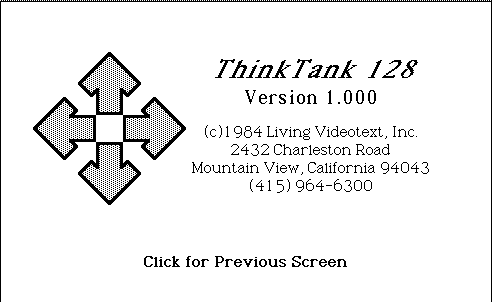
Back in 1983, a little company called Living Videotext run by Dave Winer, who had developed a couple products for the Apple II, saw an opportunity to bring their product to the Macintosh. Their product, ThinkTank, was the fourth title to ship for the new Macintosh released in 1984.

Thinktank was an “idea processor“, not a word processor, but “a tool for organizing your thoughts on a computer screen. You could create an outline, then indent, move an item up a list, or out a level. Flesh out the details, and quickly record a top-level idea you had overlooked.” It was the beginning of outliner tools created by the company.

% hexdump -C Sample | head
00000000 2e 48 45 41 44 20 30 20 2b 20 20 4d 61 6a 6f 72 |.HEAD 0 + Major|
00000010 20 4c 65 61 67 75 65 20 42 61 73 65 62 61 6c 6c | League Baseball|
00000020 20 54 65 61 6d 73 0d 2e 48 45 41 44 20 31 20 2b | Teams..HEAD 1 +|
00000030 20 20 4c 65 61 67 75 65 73 20 61 6e 64 20 44 69 | Leagues and Di|
00000040 76 69 73 69 6f 6e 73 0d 2e 48 45 41 44 20 32 20 |visions..HEAD 2 |
00000050 2b 20 20 41 6d 65 72 69 63 61 6e 20 4c 65 61 67 |+ American Leag|
00000060 75 65 0d 2e 48 45 41 44 20 33 20 2b 20 20 57 65 |ue..HEAD 3 + We|
00000070 73 74 65 72 6e 20 44 69 76 69 73 69 6f 6e 0d 2e |stern Division..|
00000080 48 45 41 44 20 34 20 2d 20 20 43 61 6c 69 66 6f |HEAD 4 - Califo|
00000090 72 6e 69 61 20 41 6e 67 65 6c 73 0d 2e 48 45 41 |rnia Angels..HEA|

The files created by ThinkTank are plain text with the ASCII “HEAD”. There was also a DOS version of ThinkTank, but the files used were .DB and .SAV, although the templates in the .TXT format did use this same format.

% hexdump -C SAMPLE.TXT | head
00000000 2e 48 45 41 44 20 30 20 2b 20 20 50 65 72 66 6f |.HEAD 0 + Perfo|
00000010 72 6d 61 6e 63 65 20 52 65 76 69 65 77 0d 0a 2e |rmance Review...|
00000020 48 45 41 44 20 31 20 2d 20 20 4e 61 6d 65 3a 20 |HEAD 1 - Name: |
00000030 0d 0a 2e 48 45 41 44 20 31 20 2d 20 20 4a 6f 62 |...HEAD 1 - Job|
00000040 20 54 69 74 6c 65 3a 20 0d 0a 2e 48 45 41 44 20 | Title: ...HEAD |
00000050 31 20 2d 20 20 52 65 76 69 65 77 20 44 61 74 65 |1 - Review Date|
00000060 3a 20 0d 0a 2e 48 45 41 44 20 31 20 2d 20 20 52 |: ...HEAD 1 - R|
00000070 65 76 69 65 77 20 70 65 72 69 6f 64 20 66 6f 72 |eview period for|
00000080 3a 20 0d 0a 2e 48 45 41 44 20 31 20 2b 20 20 4f |: ...HEAD 1 + O|
00000090 62 6a 65 63 74 69 76 65 73 20 4d 65 74 2f 4e 6f |bjectives Met/No|

Turns out this was a special format they called “dot-head“, aptly named for the head of the file. It was used as an interchange format to move outlines between ThinkTank, another program called Ready!, and the later product MORE.

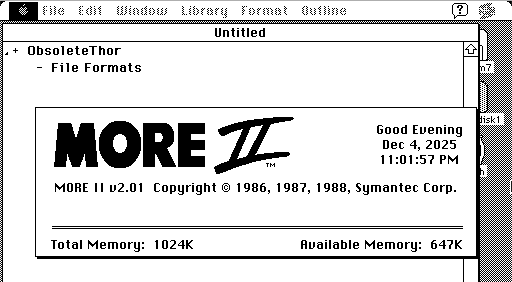
MORE was developed to be multiple tools in one. Meant to “Unite idea processing technology with the desktop publishing revolution“. MORE replaced ThinkTank in 1986 and promised more flexibility by creating charts and presentations quickly from your outline. MORE used the same dot-head format initially, also the ASCII could be in lowercase.

% hexdump -C MORE1 | head
00000000 2e 68 65 61 64 20 30 20 2b 20 20 48 6f 6d 65 0d |.head 0 + Home.|
00000010 2e 68 65 61 64 20 31 20 2d 20 20 0d 2e 68 65 61 |.head 1 - ..hea|
00000020 64 20 31 20 2d 20 20 54 65 73 74 69 6e 67 0d 2e |d 1 - Testing..|
00000030 68 65 61 64 20 31 20 2d 20 20 0d |head 1 - .|

In 1987 Living Videotext was purchased by Symantec. Shortly after Symantec released MORE II and a rebranded DOS application called GrandView based on ThinkTank.

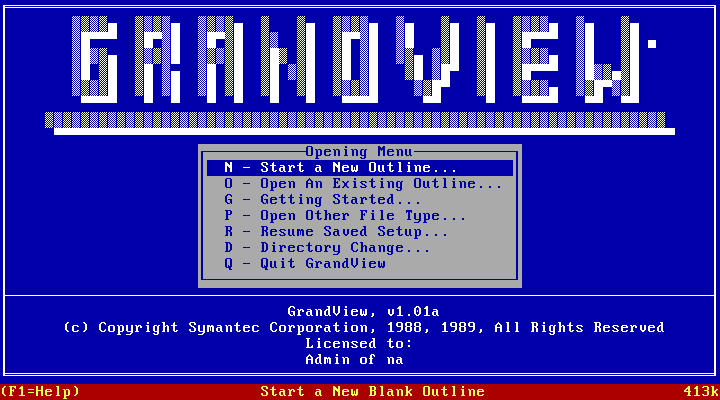
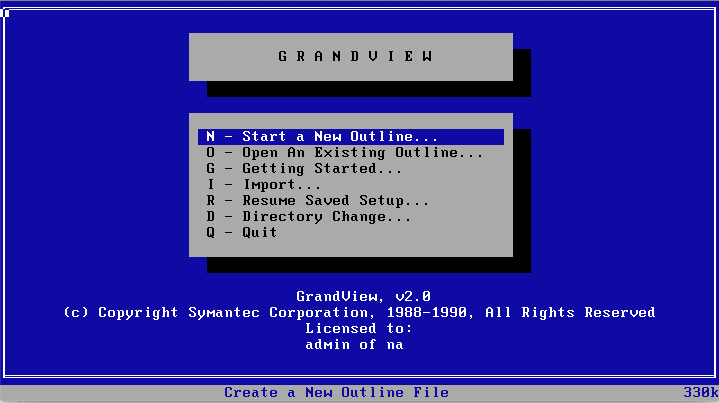
Let’s take a look at GrandView, it was built from the DOS version of ThinkTank and compatible with the same formats. It had great reviews at the time and provided the first outliner for Symantec. It was written by the developer, John Friend, who created PC Outline which was often bundled with WordStar.

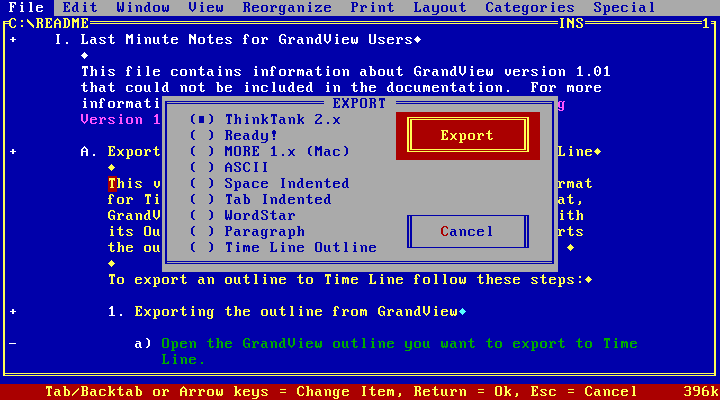
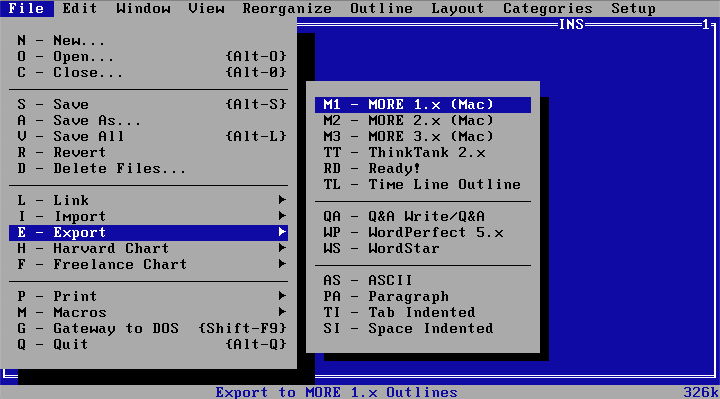
GrandView could import and export into any of the other products.

GrandView version 1 went with a new file format.

% hexdump -C PROJECT.GV | head
00000000 0b 00 01 00 1a 4a 4c 46 5f 49 44 06 00 02 00 01 |.....JLF_ID.....|
00000010 01 0a 00 03 00 16 00 26 00 2c 00 05 00 05 00 78 |.......&.,.....x|
00000020 06 00 07 00 ff ff 06 00 1a 00 01 00 26 00 08 00 |............&...|
00000030 26 00 ee 4d 02 00 00 00 c0 a8 00 00 00 00 00 00 |&..M............|
00000040 01 00 00 00 00 00 01 00 00 00 00 00 00 00 00 01 |................|
00000050 00 00 22 00 0a 00 20 1c 00 00 20 1c 00 00 d0 b6 |.."... ... .....|
00000060 00 00 10 ef 00 00 20 1c 00 00 20 1c 00 00 60 35 |...... ... ...`5|
00000070 01 00 01 00 05 00 10 00 62 15 00 13 00 cc 93 88 |........b.......|
00000080 10 54 54 59 2e 50 44 56 00 00 00 00 00 00 2c 00 |.TTY.PDV......,.|
00000090 1c 00 00 00 00 00 00 00 00 00 00 00 00 00 00 00 |................|

GrandView 2.0 also used the same format.

% hexdump -C TEST.GV | head
00000000 0b 00 01 00 1a 4a 4c 46 5f 49 44 06 00 02 00 01 |.....JLF_ID.....|
00000010 02 0a 00 03 00 02 00 2b 00 3a 00 05 00 05 00 78 |.......+.:.....x|
00000020 06 00 07 00 ff ff 26 00 08 00 2b 00 d5 3e 02 00 |......&...+..>..|
00000030 00 00 d0 b6 00 00 00 00 00 00 01 00 00 00 00 00 |................|
00000040 01 00 00 00 00 00 00 00 00 01 00 00 22 00 0a 00 |............"...|
00000050 20 1c 00 00 20 1c 00 00 d0 b6 00 00 10 ef 00 00 | ... ...........|
00000060 20 1c 00 00 20 1c 00 00 60 35 01 00 01 00 05 00 | ... ...`5......|
00000070 10 00 60 15 00 13 00 9b 5d 83 14 48 50 4c 33 2e |..`.....]..HPL3.|
00000080 50 44 56 00 00 00 00 00 2c 00 1c 00 00 00 00 00 |PDV.....,.......|
00000090 00 00 00 00 00 00 00 00 00 00 00 00 00 00 00 00 |................|

GrandView was also compatible with the Macintosh counterpart, MORE.

Symantec then released a new version of the MORE software for the Macintosh in 1988, adding new presentation features. MORE II went away from the dot-head format and used a new proprietary format.

% hexdump -C MORE2-s01 | head
00000000 00 03 4d 52 49 49 00 80 00 00 00 80 00 00 00 78 |..MRII.........x|
00000010 00 00 00 00 00 00 00 00 00 00 00 f8 00 00 00 a8 |................|
00000020 00 00 01 a0 00 00 00 28 00 00 01 c8 00 00 00 18 |.......(........|
00000030 00 00 01 e0 00 00 00 00 00 00 01 e0 00 00 00 0c |................|
00000040 00 00 01 ec 00 00 00 0c 00 00 01 e0 00 00 00 00 |................|
00000050 00 00 00 00 00 00 00 00 00 00 00 00 00 00 00 00 |................|
*
00000080 00 03 00 00 00 48 00 48 00 00 00 00 02 d8 02 28 |.....H.H.......(|
00000090 ff e1 ff e2 02 f9 02 46 03 47 05 28 03 fc 00 02 |.......F.G.(....|
000000a0 00 00 00 48 00 48 00 00 00 00 02 d8 02 28 00 01 |...H.H.......(..|

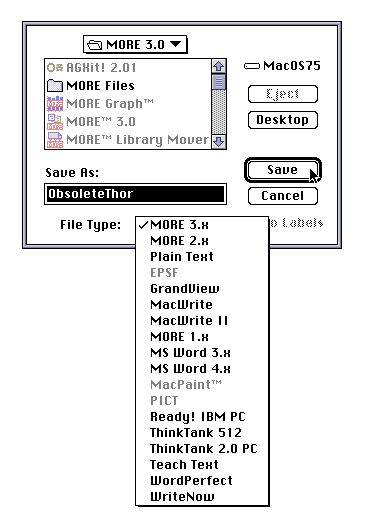
Then in 1990 Symantec released MORE 3.0 with even more features and improvements to the user experience. Also adding a companion tool, MORE Graph.

% hexdump -C MORE3-s01 | head
00000000 00 06 4d 4f 52 33 00 80 00 00 00 80 00 00 00 78 |..MOR3.........x|
00000010 00 00 00 f8 00 00 01 b4 00 00 02 ac 00 00 00 a8 |................|
00000020 00 00 11 16 00 00 00 32 00 00 11 48 00 00 00 20 |.......2...H... |
00000030 00 00 11 68 00 00 00 00 00 00 11 68 00 00 00 10 |...h.......h....|
00000040 00 00 11 83 00 00 00 0c 00 00 11 68 00 00 00 00 |...........h....|
00000050 00 00 00 00 00 00 03 54 00 00 0d c2 00 00 11 78 |.......T.......x|
00000060 00 00 00 0b 00 00 00 00 00 00 00 00 00 00 00 00 |................|
00000070 00 00 00 00 00 00 00 00 00 00 00 00 00 00 00 00 |................|
00000080 00 03 00 00 00 48 00 48 00 00 00 00 02 d8 02 28 |.....H.H.......(|
00000090 ff e1 ff e2 02 f9 02 46 03 47 05 28 03 fc 00 02 |.......F.G.(....|

The MORE 3 format got a new header but appears similar in structure to the previous version. And the new companion tool MORE Graph had yet another format.

% hexdump -C MORE3-graph | head 
00000000 00 01 00 00 01 09 00 00 00 0c 00 01 09 19 80 00 |................|
00000010 01 09 54 65 73 74 00 00 00 07 00 01 00 03 00 00 |..Test..........|
00000020 00 0b 00 00 00 00 00 00 00 00 00 00 00 00 00 00 |................|
00000030 00 00 00 00 00 00 00 00 00 00 00 00 00 00 00 00 |................|
*
00000610 00 00 00 00 00 00 00 01 06 47 65 6e 65 76 61 00 |.........Geneva.|
00000620 00 00 00 00 00 00 00 00 00 00 00 00 00 00 00 00 |................|
*
00000670 01 00 00 1f ca 33 a0 00 2b 00 04 02 d8 03 d8 09 |.....3..+.......|
00000680 57 6f 72 6b 73 68 65 65 74 00 00 00 00 00 00 00 |Worksheet.......|

Luckily these early Macintosh based formats didn’t use a resource fork, making them fully compatible with their PC counterpart.

One of the coolest parts of this long list of outline software, is that years later, after Symantec discontinued the product, the original creator, Dave Winer, petitioned Symantec to allow him to release the antique software free and clear to the public. How cool is that? I would really like to see this happen more as other software titles die and get swept under the rug leaving the community to try and find copies, preserve them and make sense of the formats. Not only were the early versions made available, a tool was built to migrate the MORE format to more open XML, allowing the ideas trapped in these ancient formats to be re-imagined.

MORE 3.1 was the final version of the software to be released by Symantec. The files produced by MORE 3.1 have an identical header to the standard 3.0 version. Probably only need one signature for the two versions.

% hexdump -C MORE31-s01 | head 
00000000 00 06 4d 4f 52 33 00 80 00 00 00 80 00 00 00 78 |..MOR3.........x|
00000010 00 00 00 f8 00 00 01 b4 00 00 02 ac 00 00 00 a8 |................|
00000020 00 00 11 16 00 00 00 32 00 00 11 48 00 00 00 20 |.......2...H... |
00000030 00 00 11 68 00 00 00 00 00 00 11 68 00 00 00 10 |...h.......h....|
00000040 00 00 11 83 00 00 00 0c 00 00 11 68 00 00 00 00 |...........h....|
00000050 00 00 00 00 00 00 03 54 00 00 0d c2 00 00 11 78 |.......T.......x|
00000060 00 00 00 0b 00 00 00 00 00 00 00 00 00 00 00 00 |................|
00000070 00 00 00 00 00 00 00 00 00 00 00 00 00 00 00 00 |................|
00000080 00 03 00 00 00 48 00 48 00 00 00 00 02 d8 02 28 |.....H.H.......(|
00000090 ff e1 ff e2 02 f9 02 46 03 47 05 28 03 fc 00 02 |.......F.G.(....|

If you would like to try out the MORE software, download this disk image, and drag onto the Macintosh emulator below. The image will automatically mount and you should be able to take MORE 3.1 for a spin!

Outlining software still has a good place in idea generation and presentation. OmniOutliner can probably trace its roots to these “Antique” titles! Stay tuned for some PRONOM signatures to go along with these many format examples. For now you can gather some of the samples from my Github page.